 Skip to content


Your miner is running. Shares are accumulating. The pool dashboard shows a growing balance with your name on it. And then comes the question every new miner eventually asks: where does the money actually go?
The answer is a crypto wallet — and understanding how wallets work is not optional. It is the difference between truly owning your mining rewards and just having a number on someone else’s screen.—
Estimated reading time: 10 minutes
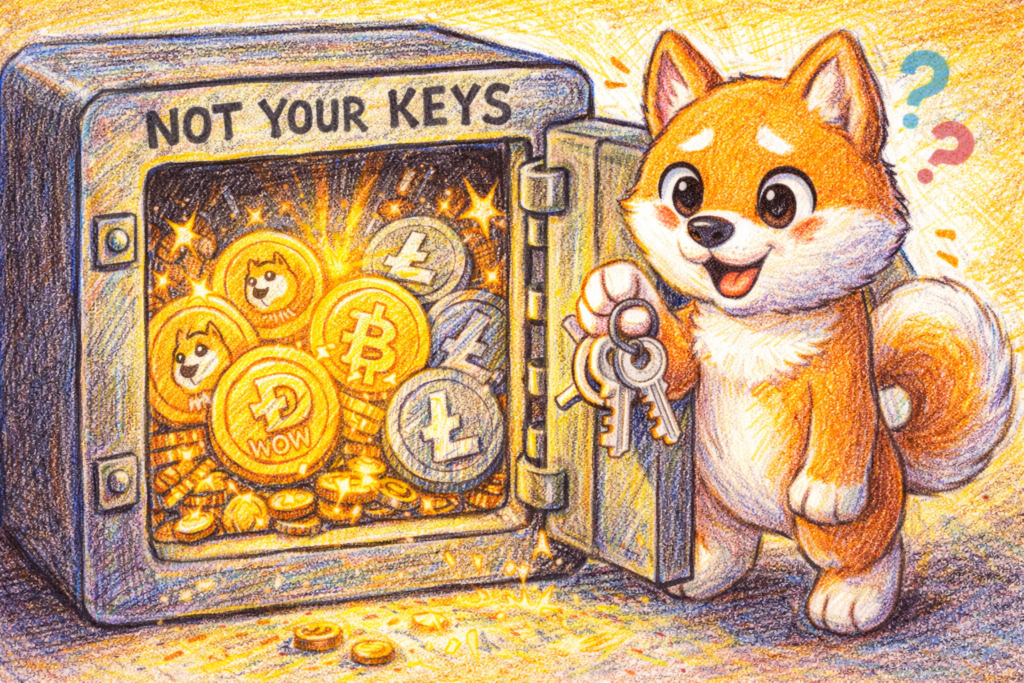
The name is slightly misleading. A crypto wallet does not store your coins the way a physical wallet holds cash. Your coins never actually leave the blockchain — they live there permanently, recorded in the ledger. What your wallet stores is the private key: a cryptographic password that proves you have the right to move those coins.
Think of it this way: the blockchain is a public scoreboard showing every account balance. Your wallet is the only thing that can sign a transaction on your behalf — proving to the network that you authorised the move. Lose your private key, and your coins sit on the scoreboard forever with no way to touch them. Someone else gets your private key, and your balance is gone in minutes.
Every wallet has two components:
—
Here is the actual journey your rewards take:
Step 4 is where a lot of new miners trip up. Until the pool sends the payout, your balance exists only in the pool’s internal ledger. The pool could theoretically freeze your account, get hacked, or shut down. That balance is only yours once it lands in a wallet you control. This is the core reason choosing a reputable pool matters — and why leaving a large balance sitting on a pool dashboard indefinitely is not best practice.—

IMAGE 2 — A three-stop road: miner → pool building with balance counter in the window → glowing padlocked wallet. Sign at the final stop: “Yours. Actually yours.” Makes the payment journey visual and concrete.
All wallets fall into one of two categories, and the distinction comes down to one thing: is the private key connected to the internet?
A hot wallet is connected to the internet. This makes it fast and convenient — perfect for receiving daily mining payouts, checking balances, and moving coins to an exchange when you want to sell. The tradeoff is exposure: a hot wallet is only as secure as the device it runs on.
Best hot wallets for miners:
A cold wallet keeps your private key offline — on a physical device that never connects to the internet unless you plug it in deliberately to make a transaction. This is the gold standard for security. The only way to steal from a cold wallet is to physically steal the device itself.
Best cold wallets for miners:
For most miners, the practical setup is a combination: a hot wallet as the pool payout destination for daily inflows, with a monthly sweep of accumulated coins into cold storage. You get the convenience of frequent payouts without leaving everything exposed indefinitely.—
IMAGE 3 — Two piggy banks. One with a padlock (your keys). One sitting behind a bank teller counter with a suited figure in front of it (exchange wallet). Not threatening — just there. “Convenient. Just not technically yours until you withdraw.”
Many miners use an exchange like Newton, Shakepay, or Coinbase as their payout destination. This works — and it is fine for getting started — but it is important to understand what you actually have.
When your coins sit on an exchange, you do not hold the private key. The exchange does. You have an IOU from the exchange. This is what the phrase “not your keys, not your coins” refers to — and it is not just a slogan. Exchanges get hacked. Exchanges go bankrupt. Exchanges freeze withdrawals during periods of stress. All three have happened to major platforms in the past decade.
For small amounts or coins you plan to sell quickly, an exchange wallet is perfectly reasonable. For anything you are accumulating long-term — treating mining as a savings mechanism — self-custody in a hardware wallet is the right answer.—
If you are mining with a Scrypt ASIC and merge mining Litecoin and Dogecoin simultaneously, you need a separate wallet address for each coin. They are different blockchains — a Litecoin address cannot receive Dogecoin, and vice versa. Sending coins to the wrong address type is one of the most common and irreversible mistakes new miners make.
Quick reference:
| Coin | Address Format | Starts With | Wallet Options |
|---|---|---|---|
| Bitcoin (BTC) | Legacy / SegWit / Native SegWit | 1, 3, or bc1 | Electrum, Ledger, Trezor |
| Litecoin (LTC) | Legacy / SegWit | L or M | Exodus, Loaf Wallet, Ledger, Trezor |
| Dogecoin (DOGE) | Legacy | D | Exodus, Dogecoin Core, Ledger, Trezor |
When you set up your pool account, you will enter a separate payout address for LTC and DOGE. Double-check both addresses before saving — copy-paste directly from your wallet app, never type them by hand.—
Every wallet — hot or cold — gives you a seed phrase when you first set it up. This is typically 12 or 24 random words in a specific order. It is the master backup for your private key. If your device is lost, stolen, or destroyed, your seed phrase is all you need to recover every coin in that wallet on a new device.
How to treat your seed phrase:
Losing your seed phrase is losing your coins permanently. There is no password reset. There is no customer support line. The blockchain does not know who you are — it only knows who has the key.—
IMAGE 4 — Seed phrase on paper over a shredder (big red X) next to the same seed phrase on a metal plate in a fireproof box (green checkmark). No caption needed. The images say it.
Here is what a sensible wallet setup looks like for someone running a Scrypt miner in Canada:
You can verify any transaction at any point using a public block explorer — Blockchair for LTC and Dogechain for DOGE. Paste your wallet address and every incoming payout from your pool will be listed there in full.—
Mining earns coins. A wallet keeps them. These are two separate problems and both need to be solved properly — because a miner with no wallet is just doing work for someone else’s ledger.
The setup is not complicated once you do it once: generate a wallet, copy your addresses, enter them in your pool, store your seed phrase somewhere physical. After that it runs in the background while your miner keeps hashing and your pool keeps paying.
If you are still figuring out which machine to run behind that wallet, our full ASIC lineup is a good place to start — every machine we sell is ready to point at a pool and start filling one.

