 Skip to content


Every week someone asks some version of the same question: is mining actually worth it?
The honest answer is: it depends on five variables, and they all move simultaneously. Ask only about one of them and you will get a misleading answer. Ask about all five together and the picture becomes clear — sometimes clearly profitable, sometimes clearly not, and sometimes right on the edge where small decisions make a large difference.
This post ties everything together. If you have read any of the individual guides on this blog, this is where those pieces connect. If this is your starting point, everything below links to the deeper explanation for each variable.
Estimated reading time: 10 minutes
Mining profitability is a simple equation with a lot of moving parts:
Revenue − Costs = Profit
Revenue is determined by your hashrate, the network difficulty, and the coin price. Costs are determined by your electricity rate and your hardware efficiency. That is it. Every question about mining profitability is ultimately a question about one of these five things.—
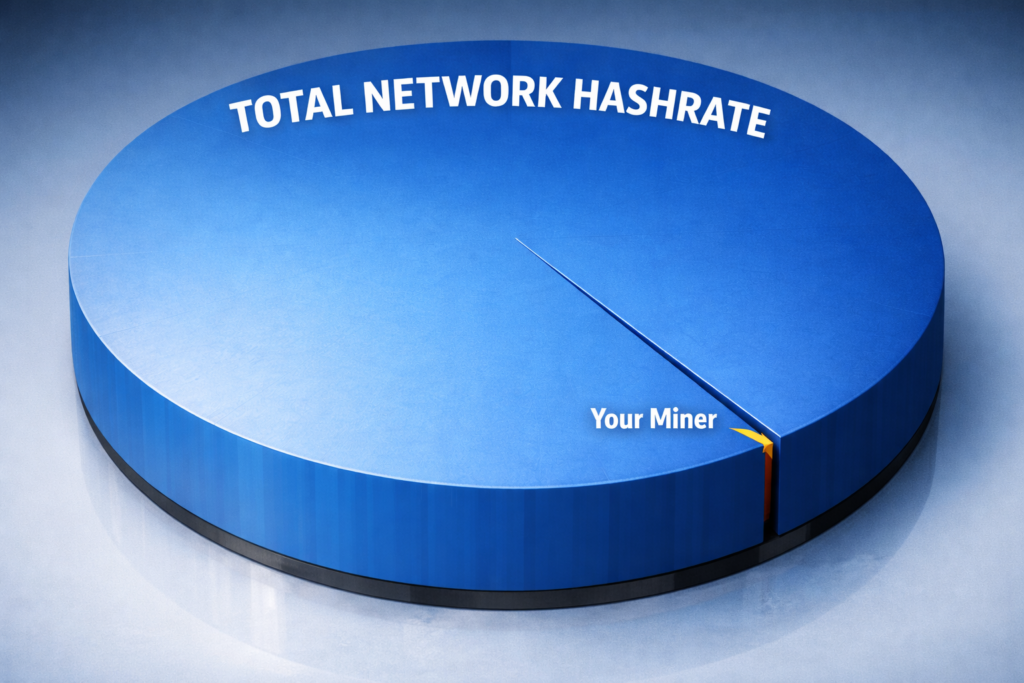
Your hashrate is your machine’s speed — how many guesses it throws at the network puzzle every second. The higher your hashrate relative to the total network, the larger your share of the block rewards.
This is the variable you lock in when you buy a machine. An Antminer L9 does 16 GH/s on day one and 16 GH/s on day 365. The machine itself does not change.
What changes is everything around it.
What you control: Which machine you buy. Whether you run it at full power or underclocked. Whether you keep it maintained so it runs at rated spec.
What you don’t control: How much total hashrate the network has. When competitors add machines, your slice of the pie shrinks — even though your machine hasn’t changed at all.—
Hardware is a one-time purchase. Electricity is a subscription you pay every single day your machine runs. Over a three-year operational life, electricity typically costs more than the machine itself.
Here is what that looks like for a single Antminer L9 (3,360W) running 24/7:
| Electricity Rate | Monthly Cost | Annual Cost | Who Pays This |
|---|---|---|---|
| $0.05 USD/kWh | ~$121 USD | ~$1,452 USD | Hosted facilities, industrial operators |
| $0.08 USD/kWh | ~$194 USD | ~$2,322 USD | Upper range of hosting, some commercial rates |
| $0.12 CAD/kWh | ~$290 CAD | ~$3,484 CAD | Quebec, Manitoba residential |
| $0.19 CAD/kWh | ~$458 CAD | ~$5,500 CAD | Ontario, BC residential |
The difference between the best and worst row above is roughly $4,000 per year on a single machine. That is not a rounding error — it is the entire question of whether mining is viable at all.
This is why Canadian miners running machines at home on residential power are often fighting an uphill battle, and why hosting facilities exist as a serious alternative — not a luxury. Access to $0.05–$0.08/kWh industrial power changes the economics of the same machine entirely.
What you control: Where you run the machine. Whether you explore hosting. Whether you underlock slightly to reduce consumption at a marginal hashrate cost.
What you don’t control: Your province’s base electricity rate. Time-of-use pricing fluctuations. The CAD/USD exchange rate if you are comparing to USD-denominated hosting rates.—
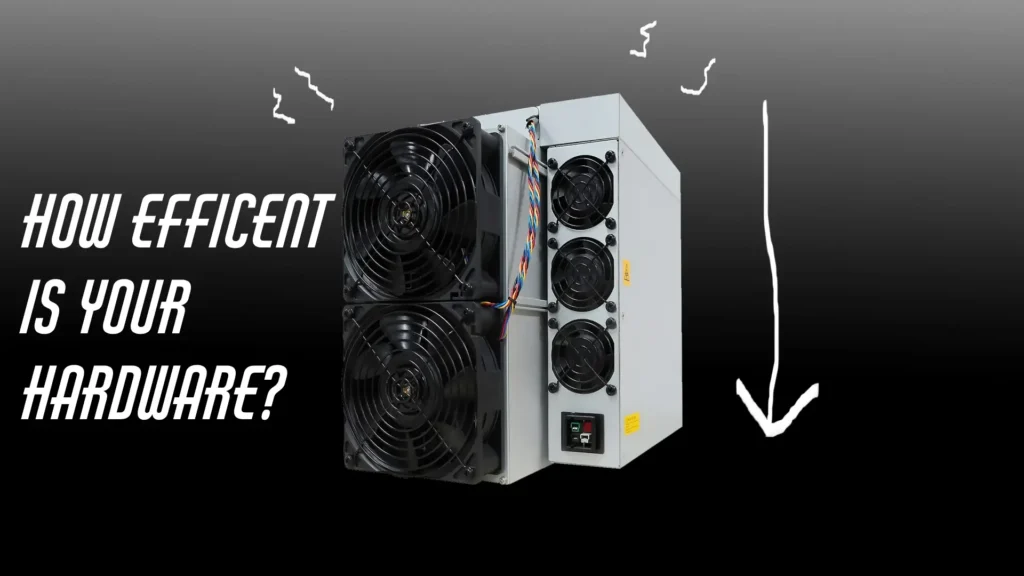
Two miners can have the same hashrate and wildly different profitability based on how much electricity they burn to produce it. This is measured in joules per megahash (J/MH) for Scrypt miners and joules per terahash (J/TH) for Bitcoin miners. Lower is always better.
| Miner | Algorithm | Hashrate | Power | Efficiency |
|---|---|---|---|---|
| Antminer L7 | Scrypt | 9.5 GH/s | 3,425W | ~0.36 J/MH |
| Antminer L9 | Scrypt | 16 GH/s | 3,360W | ~0.21 J/MH |
| Antminer L11 | Scrypt | 20 GH/s | 3,400W | ~0.17 J/MH |
| Antminer S21 | SHA-256 | 200 TH/s | 3,500W | ~17.5 J/TH |
| Antminer S21 XP | SHA-256 | 270 TH/s | 3,645W | ~13.5 J/TH |
Efficiency is what determines how long a machine stays profitable as difficulty rises and coins are halved. An efficient miner running at $0.06/kWh can survive a halving that kills an older, power-hungry machine at the same rate. This is the core argument explored in our ASIC lifespan guide — a machine has three lifespans: physical, economic, and competitive, and efficiency determines which one ends the operation first.
What you control: Which generation of hardware you buy. Whether you upgrade before efficiency becomes the binding constraint.
What you don’t control: When the next generation of chips arrives. How aggressively manufacturers improve J/TH ratios.—
Network difficulty is the mechanism that keeps block times consistent regardless of how many miners are competing. When more hashrate joins the network, the puzzle gets harder. When miners leave, it gets easier. Your machine keeps doing the same work either way — but what that work is worth changes with every adjustment.
Difficulty is why two miners with identical hardware, electricity rates, and coin prices can have different returns depending on when they started. The miner who bought in February before a wave of new machines came online earned more per day than the miner who bought in April after difficulty adjusted upward.
This interplay between difficulty and hashrate also shapes the post-halving cycle that repeats every few years on Bitcoin and Litecoin. After a halving cuts the block reward, the least efficient miners shut off. Network hashrate drops. Difficulty adjusts down. Remaining miners temporarily earn a larger share — until the rising coin price draws new machines back in and difficulty climbs again.
You can track real-time difficulty adjustments for Bitcoin at mempool.space and for Litecoin at BitInfoCharts.
What you control: When you enter — buying when difficulty is high relative to coin price is the wrong time. Buying when inefficient machines are shutting off and difficulty is softening is the right time.
What you don’t control: The adjustment itself. The behaviour of other miners globally.—
The same machine, same electricity rate, same difficulty, same efficiency. Change only the coin price and you change everything.
This is the variable with the widest range and the least predictability — and yet it is also the variable that makes mining uniquely attractive compared to simply buying crypto. When you mine instead of buy, you accumulate coins at a consistent rate regardless of price. A rising coin price does not change your cost basis in the coins you mined at $0.06/kWh — it just increases the value of what you already hold.
For Scrypt miners earning both LTC and DOGE simultaneously, coin price exposure is doubled. Two independent price variables, both moving independently, both affecting the same machine’s output. In bull markets this is exceptional. In bear markets it means two revenue streams compressed at once — which is why electricity cost efficiency becomes even more critical during downturns.
What you control: When you sell or hold. Whether you convert immediately to CAD or accumulate through cycles.
What you don’t control: The market. Nobody does.—
Here is the same Antminer L9 under three different real-world scenarios:
| Scenario | Electricity | DOGE Price | Difficulty | Result |
|---|---|---|---|---|
| Home miner, bear market | $0.17 CAD/kWh | Low | High | Losing money monthly |
| Hosted miner, bear market | $0.06 USD/kWh | Low | High | Marginal — breakeven or slight loss |
| Hosted miner, bull market | $0.06 USD/kWh | High | Rising | Strongly profitable |
The machine is identical in all three rows. The difference is entirely in the variables around it.
This is why the question “is mining profitable?” has no universal answer — only an answer specific to your situation right now. Use a profitability calculator like WhatToMine to plug in your exact numbers. Our profitability calculator guide explains what these tools get right, what they get wrong, and how to use them without being misled by today’s numbers as a proxy for tomorrow’s.—
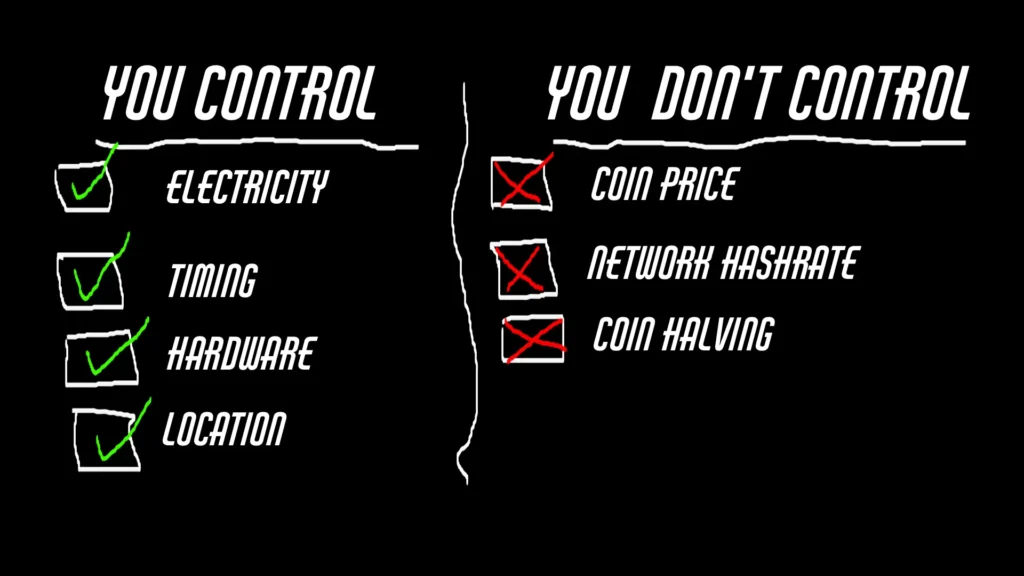
The most useful reframe in mining is separating what you can influence from what you cannot. A miner who obsesses over coin price is spending energy on the wrong variable. A miner who quietly secures a better electricity rate, buys the most efficient hardware available, and enters during a soft difficulty period has stacked every variable they can control in their favour — and then let the market do what it does.
The variables you control:
Before buying a machine, run through these five questions in order:
—
Mining is not gambling and it is not guaranteed income. It is a business with five inputs, two of which you control completely, one you influence through timing, and two you simply have to accept. The miners who consistently come out ahead are not the ones who predicted the coin price correctly — they are the ones who relentlessly optimised the variables on their side of the ledger.
Efficient hardware. Low electricity. A reputable pool. Proper custody of their coins. Entry when difficulty is soft. Everything else is noise.
If you are working through this for the first time, the rest of the blog exists to go deep on each piece. Start with electricity — it is the variable that disqualifies the most setups before anything else. Then work through hashrate and difficulty. By the time you run your numbers through a profitability calculator, you will know exactly what you are looking at.
👉 Browse our current ASIC lineup — every machine listed includes efficiency specs so you can run the numbers before you buy.

