 Skip to content

Estimated reading time: 9 minutes
One of the strangest and most elegant things about crypto mining is that sometimes the same work can count for two different networks at once. That is exactly what merge mining Litecoin and Dogecoin is all about: one machine, one energy cost, two reward streams running in parallel.
Merged mining is exactly that.
It sounds like a loophole. It is not. It is a deliberate design decision that has become a core part of how both the Litecoin and Dogecoin ecosystems function today. If you are running a Scrypt miner, or thinking about getting into Litecoin and Dogecoin mining, understanding merge mining is essential.
To understand why merged mining exists, you have to understand the relationship between the two networks.
Merge mining is when one piece of hardware works on two blockchains at once. Both chains use the same algorithm, so your miner can submit work to both networks without using extra energy.
Mining is fundamentally about proving that computational work has been done. A miner repeatedly hashes data until it produces a value that satisfies the difficulty requirements of the network. This process secures the blockchain and determines which miner earns the block reward.
What makes merged mining possible is that multiple blockchains can accept the same proof-of-work if they share the same hashing algorithm. Both Litecoin and Dogecoin use the Scrypt algorithm.
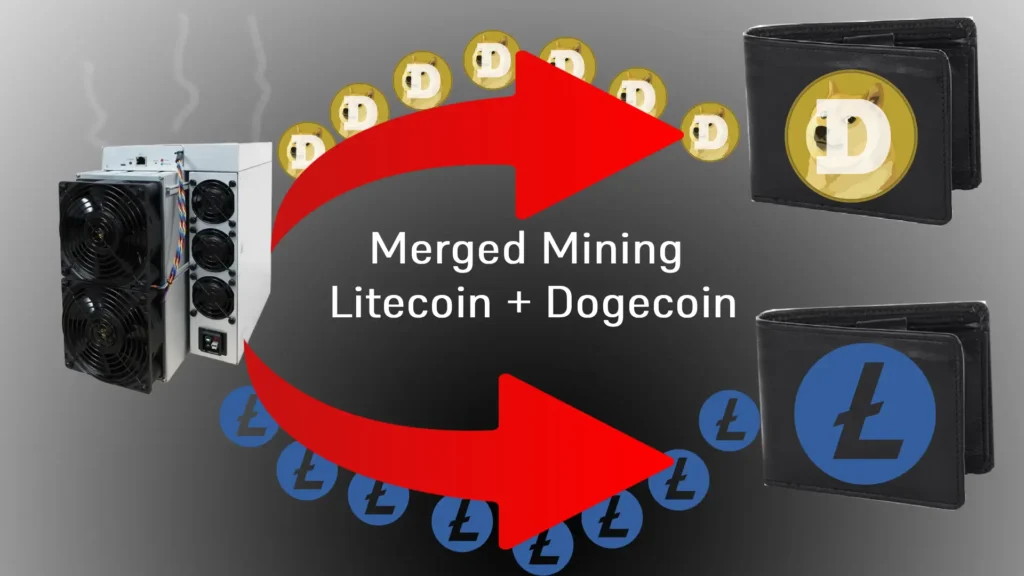
Because of this, the work performed by a Scrypt ASIC miner can be valid for both networks simultaneously. Instead of discarding hashes that fail to meet Litecoin’s difficulty target, those hashes can still be checked against Dogecoin’s difficulty target. This means a single mining process can effectively be evaluated twice. The miner does not divide their hashrate between chains. The miner simply produces Scrypt hashes and the pool distributes those hashes wherever they are valid. From the miner’s perspective, nothing changes operationally. The machine still performs the same work. The electricity usage is identical. The difference lies entirely in how that work is accounted for.
This is why merged mining is often summarized as “two payouts for the same work,” but the deeper reality is that it is two networks recognizing the same cryptographic effort.
Think of it like turning in the same homework assignment to two different teachers. Both accept it, and you get credit twice.
Merged mining was not part of Dogecoin’s original design. In its early days, Dogecoin miners secured the network independently. But as Litecoin’s mining ecosystem grew much larger, a security gap opened up. A blockchain’s protection is directly tied to how much computational power is backing it. Dogecoin, running on the same algorithm as Litecoin but with far less hashpower, was becoming increasingly vulnerable.
Merged mining solved this.
Merged mining solved this. By allowing Dogecoin blocks to be mined alongside Litecoin blocks, Dogecoin effectively inherited the security of Litecoin’s much larger network. For Dogecoin, it was a survival mechanism. For miners, it became an effortless bonus.
This is why nearly all Dogecoin mining today happens through merge mining with Litecoin. The two networks are permanently intertwined at the infrastructure level.
From a practical standpoint, merge mining is almost invisible to the operator. Your Scrypt ASIC connects to a mining pool just like any other machine. The pool handles everything behind the scenes: distributing work templates, evaluating hashes, and routing rewards across both networks. You configure once, and it just runs.
When the pool finds a hash that satisfies Litecoin’s difficulty, LTC rewards get distributed. When that same hash also satisfies Dogecoin’s lower difficulty target, DOGE rewards follow. Your machine never pauses, never switches, never slows down. Same stream of hashes, two networks secured.
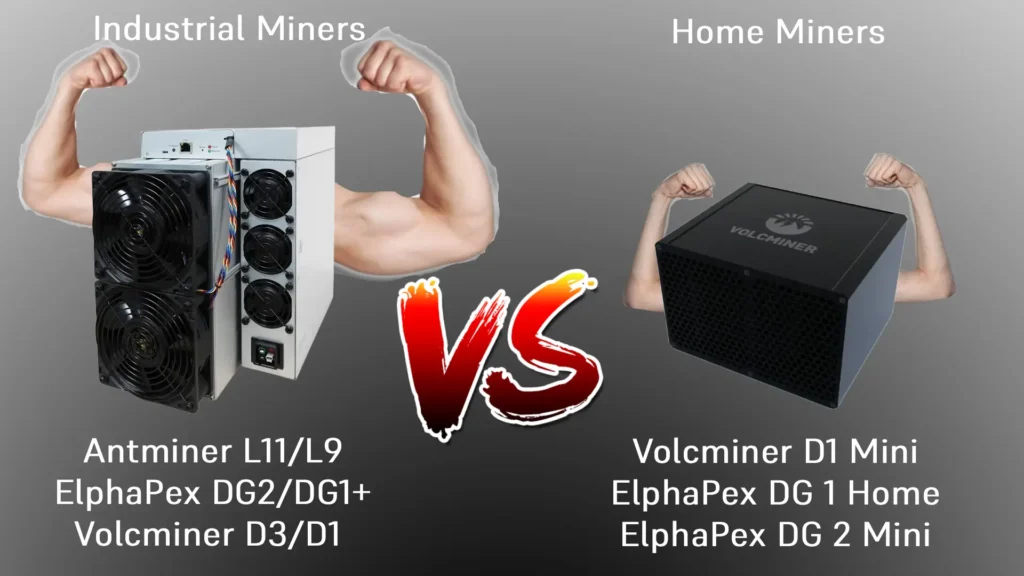
If you want to mine at scale, you need a purpose-built Scrypt ASIC. These machines are noisy, power-hungry, and not cheap, but they are the only practical way to mine Litecoin and Dogecoin profitably at volume. The top options available at Lazy Miners:
Not ready for industrial hardware? These compact Scrypt miners are built for home use. They will not make you rich overnight, but they are a great way to learn the ropes, stack some DOGE and LTC, and understand how merge mining works in practice without needing hosting or industrial infrastructure.
Here is something worth paying attention to when evaluating merge mining returns:
As Litecoin’s rewards continue to shrink over time, Dogecoin’s stay flat. In many market conditions the DOGE portion of your merge mining rewards ends up being just as valuable, or more so, than the LTC side. That fixed reward structure is a genuine long-term advantage for Scrypt miners.
When you merge mine DOGE and LTC, your miner also picks up smaller Scrypt coins in the background, like BELLS, Luckycoin, PepeCoin, Junkcoin, Dingocoin, and Shibacoin.
Some pools (like Mining-Dutch) give you the option to keep all the coins separate if you want to manage them yourself. But most miners prefer DOGE or LTC payouts, since they’re the easiest to trade on almost any exchange.
Lazy Miners Recommendation: We have been using Litecoinpool.org for years and have always appreciated how clearly the platform presents mining data in its interface. The pool uses a PPS payout structure, which means you are paid based on the shares you submit, even if the pool does not find blocks exactly at the expected statistical average. This provides more predictable payouts for miners.
Another benefit is that by mining on a smaller pool like Litecoinpool.org, you are helping support the decentralization of the network. Payouts are distributed in both LTC(Litecoin) and DOGE(Dogecoin), making it a straightforward option for miners who want reliable rewards while contributing to a healthier mining ecosystem.

Merged mining is one of the rare genuine win-win setups in crypto. Plug in one machine, contribute hashpower to two networks simultaneously, and earn rewards from both without spending a dollar more on hardware or electricity.
For new miners, the economics are easier to stomach. Dogecoin’s frequent block rewards create a steady rhythm of payouts that smooths out the volatility of mining income. For operators running larger deployments, the appeal is pure efficiency: same ASICs, same power infrastructure, same management overhead, two revenue streams.
Litecoin and Dogecoin may be separate communities, but merged mining ties their security together permanently. Miners are the infrastructure that keeps both systems running, and in this setup that work pays double.
Work once. Get paid twice.
Ready to get started? Check out some of the top Scrypt miners available right now: the Bitmain Antminer L9 16G, the ElphaPex DG2+ 20.5G, and the VolcMiner D1 Pro 20G. Not sure which one fits your setup? Talk to us about hosting and we will help you figure it out.

