 Skip to content


When most people first hear about crypto mining, they picture plugging in a machine, pointing it at the blockchain, and waiting for coins to roll in. That is technically true. But if you are solo mining — running your hardware independently without joining a pool — the odds are stacked heavily against you, and understanding exactly how stacked helps you make a smarter decision about how to mine.
Estimated reading time: 9 minutes

Image 1 — Header A lone Shiba mascot standing at the bottom of an absolutely massive mountain. The mountain is labeled “Global Network Hashrate.” The mascot is tiny, holding a single pickaxe, looking up at it. A tiny progress bar floats above their head showing 0.0001%. Dark sky, dramatic lighting. Humorous but immediately communicates the scale problem. This sets the tone for the whole article before anyone reads a word.
Solo mining means your hardware works directly with the network, competing independently to solve the next block. No pool, no shared hashpower, no split rewards.
Think of it like buying one lottery ticket in a draw with hundreds of millions of other tickets. You might win. You probably will not. And the machine keeps drawing whether you win or not.
That risk versus reward dynamic is why most miners join a mining pool instead. Pools combine hashpower across thousands of machines and distribute rewards proportionally based on contributed shares. Smaller, consistent payouts rather than the all-or-nothing solo gamble.
Three forces work against the solo miner simultaneously:
Every major proof-of-work blockchain adjusts how hard it is to find a block based on total network hashpower. As more machines join, difficulty rises. Bitcoin’s network currently runs at hundreds of exahash per second. A single miner contributing a few terahash represents a fraction of a fraction of the total. The math is unforgiving. Read more about how network difficulty works and why it only moves in one direction over time.
You are not competing against other hobbyists. Mining farms run thousands of ASIC miners around the clock, often in professional hosting facilities with industrial power rates. A single machine at home is competing against warehouses of hashpower that never sleep.
Even if your expected value calculation says you should find one block per three months, that is a statistical average — not a schedule. You could find one tomorrow. You could go six months empty-handed. Variance is what makes solo mining genuinely brutal for small operators. Your power bill does not care about your luck.

Let us put actual numbers behind the analogy using Dogecoin, one of the most accessible solo mining targets because of its fixed 10,000 DOGE block reward and relatively lower difficulty compared to Bitcoin.
Assumptions:
Expected: approximately 0.30 blocks per 30 days, or one block every 3.3 months on average. One machine. One lottery ticket every three months on average. Could happen tomorrow. Could take a year.

Expected: approximately 1 block per week on average.
At fifteen machines you start approaching a level where solo mining has some logic to it — the variance is still real but the expected frequency is at least weekly.

Expected: approximately 1 block per day on average.
At this scale — 100 machines, likely running in a hosting facility — solo mining starts to resemble a real operation with predictable daily output. You are essentially running your own pool.
These are statistical averages, not guarantees. Solo mining is always a lottery: you could hit one tomorrow on a single machine, or run 15 machines for two months without finding one. That variance is precisely why pools exist.
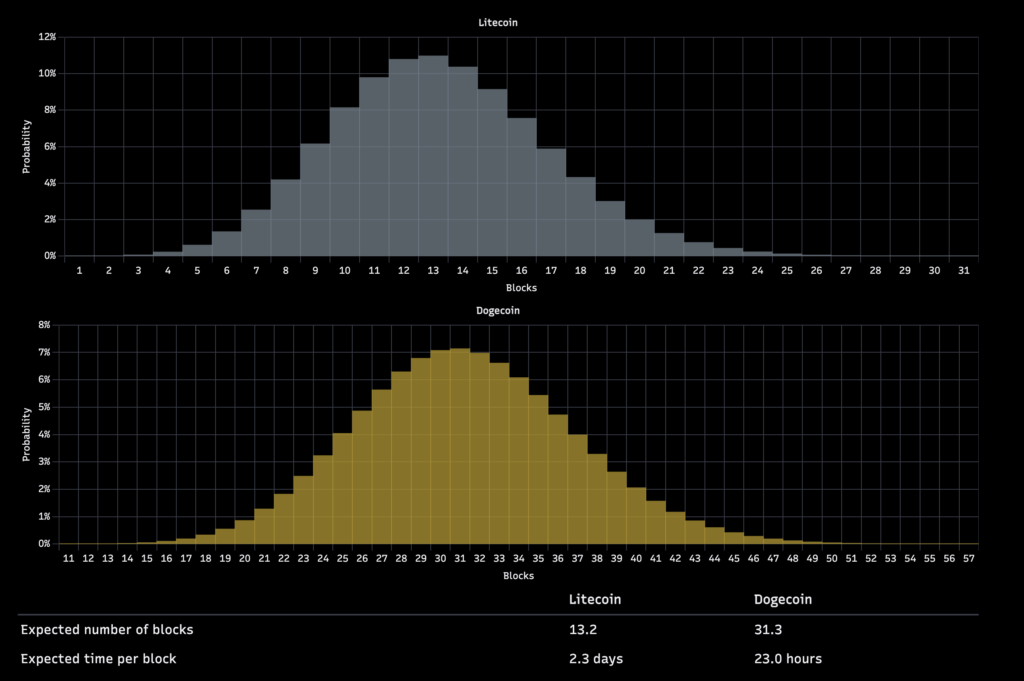
Even when the expected value is theoretically the same, variance is devastating for small operations. Here is why:
For miners with one or a handful of machines, variance is not a theoretical concern. It is the difference between a mining operation that sustains itself and one that drains your bank account while you wait on luck.
Image 2 — Variance / Paycheck Comparison Two paychecks side by side on a dark background, styled like actual pay stubs:
Left paycheck — SOLO MINER:
Right paycheck — POOL MINER:
Solo mining is not always the wrong call. There are two scenarios where it makes genuine sense:
If you are running enough hashpower that your expected block frequency is daily or better, solo mining starts to look like running your own pool — predictable output, no pool fees, full rewards. Most individual miners never reach this scale, but operators running large deployments at hosting facilities sometimes do.
This is the most interesting exception. A whole category of small, low-power home miners has emerged specifically for solo Bitcoin mining — not because the odds are good, but because the concept is embraced rather than fought. Devices like the Bitaxe Supra Hex and the NerdOCTAxe Rev 3.1 run on under 200 watts, connect directly to a solo endpoint like CKPool Solo, and give home miners a continuous low-cost ticket in the Bitcoin block reward lottery.
The framing is completely different. You are not pretending the odds are good — you know they are not. You are buying an always-on lottery ticket that also contributes to network decentralization and costs you pennies per day to run. That is a reasonable deal for what it is. Read our full breakdown in the lottery miners guide.
Image 3 — The Lottery Miner Exception (closing) The Bitaxe and NerdOCTAxe sitting side by side on a clean desk, glowing softly in a dark room. Minimal, calm, almost cozy. Text overlay in the corner: “The one time solo makes sense.” Deliberately quiet contrast to the chaotic mountain header. This image does double duty — it closes the post conceptually and visually bridges to the lottery miners guide.
Solo mining sounds appealing in theory. Keep the whole block for yourself, answer to no pool, collect the full reward. The reality is that unless you are running industrial-scale hashpower, the math works against you in a way that compounds over time through electricity costs and zero income.
Pools take the lottery and turn it into a paycheck. Smaller per share, but consistent, sustainable, and far less stressful. For almost every miner reading this, pool mining is the right call.
The exception is the lottery miner — and that exception is a feature, not a workaround. Running a Bitaxe at home is a deliberate choice to participate in Bitcoin mining on your own terms, with full awareness of the odds. That is a different thing entirely from solo mining a serious ASIC and hoping for the best.
Know what you are doing and why. That is the lazy way.

Ready to mine? Browse our full range of miners — from industrial ASICs built for pool mining to compact home lottery miners. Not sure which direction fits your goals? Our FAQ covers the most common questions, or message us directly and we will help you figure it out.

